

Shipping Household Goods to Italy
From the US
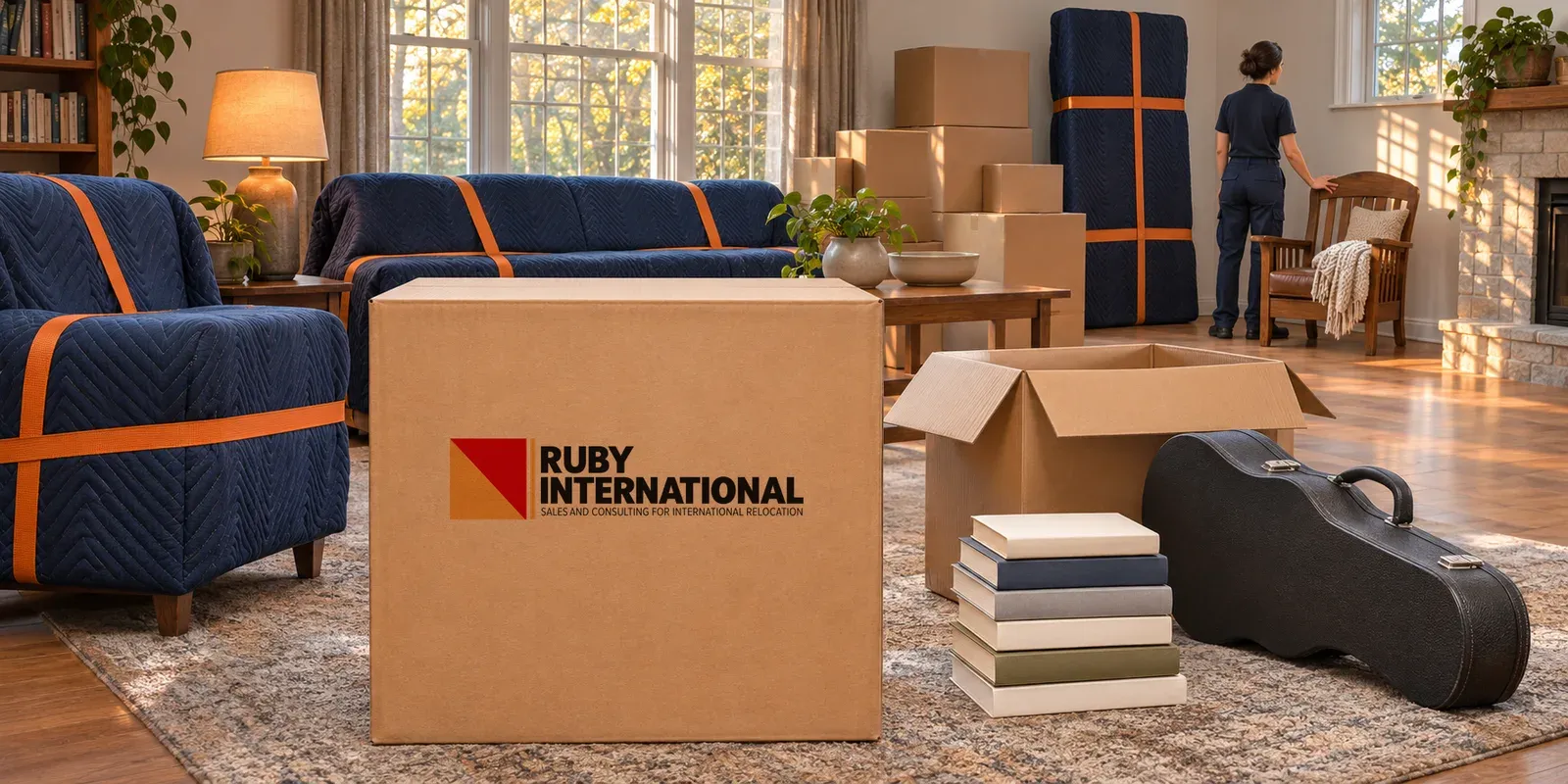
Deciding what to give up takes time, and there's no single right answer. What's worth shipping depends on what your things mean to you, what they would cost to replace in Italy, and how much space you'll have there.
Space. Homes in Italy are often smaller than US homes, and US-sized sofas, beds and wardrobes don't always fit. Measure the pieces you love before you decide.
Anything with a plug. Voltage and plugs in Italy differ from the US, so many appliances need an adapter or a converter, and large ones are often better sold and replaced there. That's our advice, not a rule.
Books, art and comfort items. These are where households decide both ways: some are glad they brought them, others would leave them next time. Both outcomes are fair.
What the relief covers. Things you've owned and used for at least six months can come in without duty or VAT, on the conditions in Bringing your goods into Italy without duty or VAT.
Not sure yet? You can store your goods while you decide, at origin, in Italy or both. Storage is charged separately.
Next step: make a rough list of what you want to bring. It's what we quote from.
You don't need a full container. We ship from a single box by air, and by sea from about 100 cubic feet; those sizes are typical, not a minimum.
Shared container. In a shared container (consolidated cargo), your goods travel in one container with other shipments. A shared load is priced by volume: the space your goods take up, in cubic feet. A full container carries only your goods.
Already living in Europe? We can arrange smaller shared loads by road between European countries (Moving to Italy from another EU country, Switzerland or the UK).
Comparing ways to send a small load. They do different jobs. A luggage or parcel shipper moves boxes and suitcases as parcels; customs papers for household goods at the Italian end are generally yours to sort out. A pallet you load yourself travels as freight, and clearance and the last stretch to your home in Italy are usually yours to arrange. A mover's shared load is packed, shipped, cleared through customs at the Italian end and delivered to your home. Whichever you choose, ask who handles customs in Italy and who delivers.
Next step: tell us roughly what you want to send, and we'll come back with the options for its size.
A household moving its residence to Italy from outside the EU can bring its used household goods in without customs duty or VAT. The relief comes from EU Regulation 1186/2009 and an Italian decree of 1997 (Ministerial Decree 489/1997), and Italian customs (ADM, Agenzia delle Dogane e dei Monopoli) applies it.
The conditions.
- You lived outside the EU for at least 12 months in a row. Less can be accepted where your intention to stay 12 months was clear.
- You owned the goods, and used them there, for at least six months before the move.
- The goods are for the same use in your new home in Italy.
- Except in special cases, you declare them within 12 months of settling in Italy, in one shipment or several.
- For 12 months after entry, you don't sell or give away, lend, hire out or pledge them without notifying customs first, and doing any of these in that time makes duty payable.
Proof of your move. The law accepts any one of these: the residence certificate from your comune (the town hall); a declaration from the Italian consulate where you live now; or other papers the customs office accepts.
The customs form. ADM's form F-01 A asks for proof that you lived abroad (an employer's letter, a lease or a deed, for example); for Italy, your residence self-declaration or, instead, a copy of the residence application you've already made to the comune, with the papers the form lists beside it (a lease or deed, a utility contract, an employer's letter or employment contract); a list of your goods; for a car, proof of its six months' use abroad; and ID. A delegate can file it for you.
Returning to Italy as a citizen? Your consulate can issue a declaration; practice varies by consulate, so ask yours early.
Not covered by the relief: alcohol, tobacco, commercial vehicles, and professional equipment other than portable instruments of the applied or liberal arts. Goods that don't qualify don't get the exemption from duty and VAT.
Furnishing a second home? The relief needs a transfer of residence, so furnishing a second home in Italy is not covered by it.
Your papers, checked twice. Our destination agent reviews your customs papers before your shipment leaves and again after departure.
Pets have their own entry rules; check them with your vet early.
Checked November 2026 against EU Regulation 1186/2009, Italian customs (ADM) and Ministerial Decree 489/1997. Rules change, and customs offices can apply them differently; we confirm what applies to your shipment. This is not legal advice.
Next step: check which proof of your move you'll have, and when you'll have it.
Visas, residence and moving dates rarely line up. Here's what the rule allows, then what we advise.
- The rule. Italian customs' own form accepts a copy of the residence application you've already filed with the comune, so on the form, registration doesn't have to be finished first; how a given customs office applies it can vary. Except in special cases, you have 12 months after settling to bring your goods in, in one shipment or several.
- Goods before residence. Italian customs can release your goods before you take up residence if you undertake to do so within six months. It asks for a guarantee, an insurance policy or a deposit, in an amount the customs office sets. If your residence self-declaration doesn't reach customs within six months of the import, the deposit is not returned.
- Our advice. We generally recommend shipping once you have your visa or residence permit. The relief depends on proving your move, and a guarantee you could lose adds cost and risk. That's our reasoning, not the law. For our part, you don't need a permanent delivery address in Italy before your goods leave.
- If the dates still don't line up. Store your goods at origin, in Italy or both until you're ready; storage is charged separately. Shipping lines usually allow some free days at the port, but that isn't warehouse storage, and the days vary by line and port. When we quote, we give you an estimated transit window for your route. It's an estimate, not a guaranteed date: it depends on the sailing, routing, customs and the destination.
Next step: tell us where your visa and residence stand when you ask for a quote, and we'll plan the shipping date with you.
At the Italian end, the local work is done by our destination agent: customs clearance and delivery to your new home. We stay your one contact throughout, from the first quote to the day your goods arrive.
Charges that can arise in Italy. Destination terminal handling, port charges, customs inspections, duties and taxes, storage, difficult access and a shuttle are listed in your proposal's exclusions and billed on the final invoice if they apply.
How the price is set. Your quote is based on the volume of your goods. If the measured volume differs, we tell you: for a shared container, with a revised invoice before your shipment goes on, so you can take items out; for a full container, during loading. Carrier surcharges (fuel, war risk, congestion) can be added after booking; we tell you as early as we can.
Questions to ask any mover:
- Who clears customs in Italy?
- Who delivers to your home?
- Who files the customs form (F-01 A)?
- Is the quote based on measured volume, and does it list what it excludes?
- Is the transit time given as an estimate?
- Is the insurance offered in writing, with its rate and deductible?
- Which charges are paid at the Italian end, and to whom?
Get more than one quote, and compare them on these points.
Next step: ask us for a quote and check ours against the same list.
Door to door means we collect at your home and deliver to your new home under normal access. In a historic center, on a hilltop or down a narrow street, a full-size truck may not reach the door; a shuttle (a smaller truck that can reach the home) then takes the last stretch. Difficult access and a shuttle are listed in your proposal's exclusions and billed if they apply. Where a shuttle or difficult access is common, we check with our destination agent before you book and tell you the likely costs.
Tell us about stairs, elevators, parking and the street when you ask for a quote. Full-service door to door generally includes furniture reassembly and taking away the packing materials. Unpacking your boxes is an optional extra.
Customs duties are prohibited between EU member states. On VAT, a private household moving between EU countries is taxed on a purchase from another EU country as an intra-EU acquisition only when it is a new means of transport, such as a car in its first six months of use or with 6,000 km or less. Your used household goods aren't a purchase, so they generally aren't taxed again because they move with you.
Through our network of moving agents, we can arrange smaller shared loads by road between European countries, for example from Germany to Italy.
Switzerland is outside the EU, so the relief in Bringing your goods into Italy without duty or VAT generally applies to a move from there.
The UK is outside the EU too, so the same generally applies, and we arrange moves from the UK to Italy.
A car can come in under the same relief if you've owned and used it abroad for at least six months before the move; the customs form asks for proof. Depending on the route, it can travel with your household goods, in its own container, or by roll-on/roll-off (RoRo: driven onto the ship and off at the port). For a car on its own, a dedicated container is often the practical choice. Electric and hybrid vehicles need extra paperwork, permits and handling, so expect extra charges and a longer booking. Our destination agent helps with the vehicle's import papers and customs.
Registering it in Italy. Apart from the cases the law exempts, once you take up residence in Italy, a car you own on foreign plates can be driven in Italy only if it is registered in Italy within three months. Driving it after the three months can bring a fine of EUR 400 to 1,600, and its registration document is taken away.
Selling your car before you leave and buying one in Italy is a real option too.
Damage is the worry nobody wants to plan for, and a few steps before the move decide how well a claim works.
Insurance. All-Risk transit insurance is optional, at 3.5% of the value you declare, with a USD 500 deductible. You may arrange your own insurance instead. The declared value is what the insurance is calculated on; the deductible is the first USD 500 of a claim.
If you pack some boxes yourself. If we pack your home and you pack some boxes yourself, leave them open so our crew can check them before sealing; they can then be considered for All-Risk cover, subject to the insurer's terms. If you pack and load everything yourself, All-Risk isn't available; Total Loss cover is, and it pays only if the whole shipment is lost.
Before the move. Keep a valued inventory with photos. Keep small valuables and documents with you rather than in the shipment; that's our advice.
If something arrives damaged. Note visible damage on the delivery papers before you sign. Report any damage within 30 days of delivery to start a claim. Our transit insurance generally covers door to door, so damage during the final delivery by our destination agent goes through the same claim, subject to the policy. We help you through the claim and answer your questions. The insurance company assesses the claim, decides what is covered and settles it, and you deal with it directly. We can't promise how long a claim takes.
Next step: decide on insurance when you book, and start your valued inventory with photos.
Publications Office of the European Union
- Council Regulation (EC) No 1186/2009 setting up a Community system of reliefs from customs duty, articles 3 to 11, checked November 6, 2026
- Council Directive 2009/132/EC (VAT exemption on the final importation of certain goods), article 3, checked November 6, 2026
- Treaty on the Functioning of the European Union (consolidated version, 2012), article 30, checked November 6, 2026
- Council Directive 2006/112/EC (the VAT Directive), article 2(1)(b)(ii) and 2(2)(b)(i), checked November 9, 2026
Agenzia delle Dogane e dei Monopoli (ADM)
- FAQ: le risposte alle domande più frequenti sulla materia doganale, checked November 6, 2026
- Franchigie doganali (forms Mod. F-01 A and Mod. F-01 B), checked November 6, 2026
Normattiva (Istituto Poligrafico e Zecca dello Stato)
- D.M. 5 dicembre 1997, n. 489, article 3, checked November 5, 2026
- D.Lgs. 30 aprile 1992, n. 285 (Codice della strada), article 93-bis, checked November 9, 2026
Consolato d’Italia ad Adelaide
- How to: rimpatrio masserizie in esenzione doganale (English sheet, 2024), checked November 6, 2026
Consolato d’Italia a Detroit
- Importazione masserizie ed esenzione doganale: istruzioni ed autocertificazione, checked November 6, 2026
Send us your move details: where from, where to, and roughly what you want to bring. We'll come back with your options.